Team Access
Manage users and access with TeamSeams's Team Access tools. Assign roles, control permissions, and delegate responsibilities across your organization from one account.
Team Access and Role Management with TeamSeams
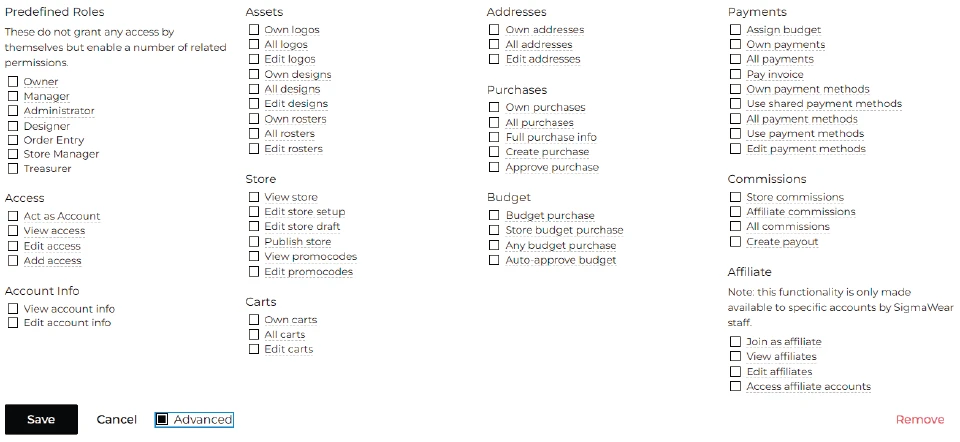
Team Access gives organizations structured control over who can access different areas of the platform and what they can do. TeamSeams includes seven predefined roles along with granular permissions, allowing responsibilities to be assigned without giving every user the same level of access.
Introduction to Team Access
Team Access provides a structured way to manage responsibilities across design, finance, ordering, stores, and account administration. Predefined roles establish a starting set of permissions, while advanced controls allow access to be adjusted when a workflow requires something more specific. Whether you're managing a school program, merchandise operation, or larger organization, access can be aligned with each person's responsibilities.
How Team Access Works
Each user can be assigned one of seven predefined roles, such as Designer, Treasurer, or Store Manager. These roles determine which areas of the platform they can access. Granular permissions can then be used to adjust those defaults and control visibility or actions on a more detailed basis.
7 Predefined Roles
The predefined roles cover common responsibilities across account administration, design, ordering, store management, and finance. Each role establishes an appropriate starting level of access that can be further customized when needed.
- Owner: Full access to all platform features, financial data, and settings. The Owner has the highest level of control and can oversee account-wide activity and configuration.
- Manager: Broad access across platform functions without the same level of financial control as the Owner.
- Administrator: Supports day-to-day account administration, including user access and permissions, while maintaining limited access to sensitive financial data.
- Designer: Access to design and customization tools for managing the visual elements of products without unrelated administrative access.
- Order Entry: Access to ordering and related operational functions without exposing unnecessary financial or administrative data.
- Store Manager: Access to manage assigned stores, including products, pricing, and store operations.
- Treasurer: Access to financial transactions, invoicing, and reporting while remaining restricted from unrelated management functions.
Advanced Permissions
Advanced permissions provide more granular control beyond the predefined roles. Permissions can be adjusted for an individual user when their responsibilities do not fit neatly within a single preset role.
Granular Access Control
After assigning a primary role, individual permissions can be enabled or disabled to control what a user can view or manage. This allows access to reflect the actual responsibilities of the person using the account rather than forcing every workflow into the same permission structure.
Flexible Without Sacrificing Control
Combining predefined roles with configurable permissions makes Team Access suitable for both straightforward account structures and more complex organizations. Users receive the access required for their work without unnecessarily exposing unrelated tools, settings, or sensitive information.